


Tram Chim National Park: Not Just a Place to See Red-Headed Cranes
Tram Chim National Park is more than a place to see sarus cranes. Learn when to visit, what wildlife to see, boat routes, costs and day-trip options.
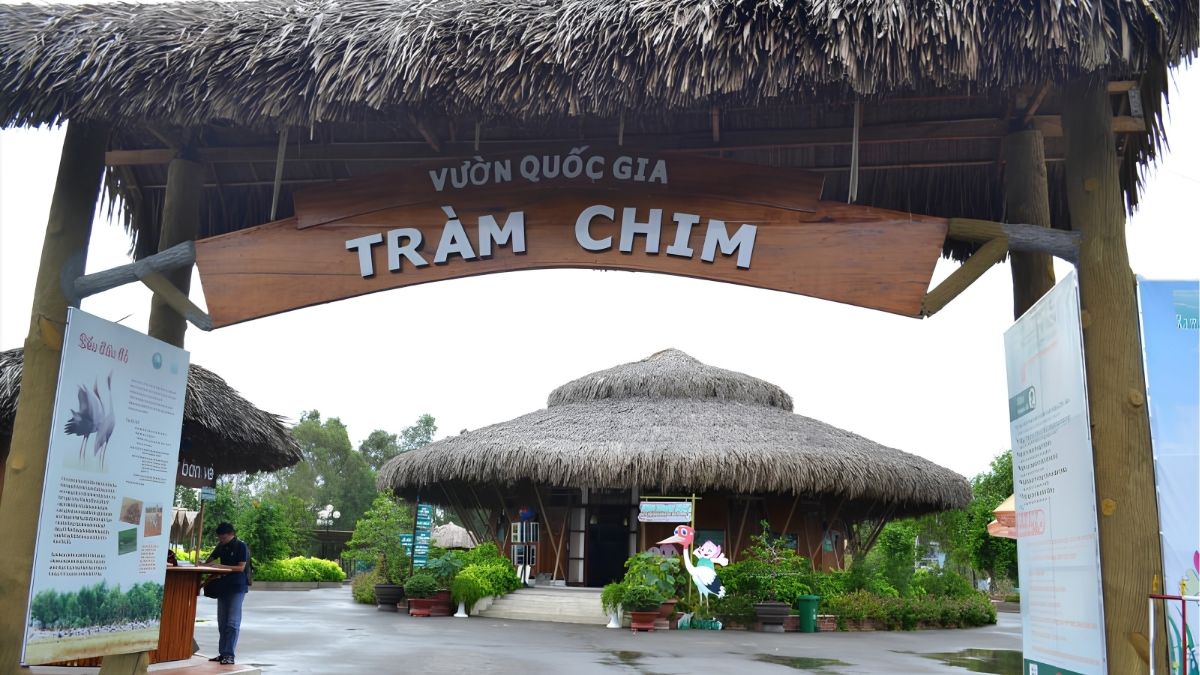
Tram Chim National Park is best known for its sarus cranes, but there is more to the wetland than crane sightings. From its open grasslands and Melaleuca forests to the many birds that live across the park, the landscape offers plenty to experience in different seasons. Let’s take a closer look at what makes Tram Chim worth visiting today.
Where is Tram Chim National Park?
Tram Chim sits in Tam Nong District, Dong Thap Province, within the Dong Thap Muoi region, commonly known in English as the Plain of Reeds. The park covers roughly 7,588 hectares of seasonal wetland, established in 1998 to protect one of the last intact remnants of this once-vast ecosystem (Source: Wikipedia). It's one of the few places in the entire Mekong Delta where the original Plain of Reeds landscape, shallow floodwater, reed grass, and melaleuca stands, still exists close to its natural state rather than having been drained for rice cultivation decades ago.

Tram Chim sits in Tam Nong District, Dong Thap Province, within the Dong Thap Muoi region (Source: Vietnam Tourism)
A self-guided visit is relatively affordable, with an entrance fee of around VND 20,000 per person, while boat and other transport costs vary depending on the route chosen.
In 2012, Tram Chim was recognized as Vietnam's fourth Ramsar site and the 2,000th Wetland of International Importance globally, a designation that reflects both the site's ecological significance and the international attention its conservation work has drawn (Source: Vietnam Tourism). That significance is tied directly to one bird: the sarus crane, a species that made Tram Chim one of the most closely watched conservation sites in Southeast Asia, and also one of the most quietly troubled.
 The sarus crane, or red-headed crane (Source: Hoang Thanh Thang Long)
Getting there means driving into a landscape that looks almost nothing like the rest of the delta's fruit orchards and river towns, flat, open, and green in every direction, with the horizon dissolving into reed grass rather than buildings. That shift in scenery alone is part of what makes Tram Chim worth the drive, regardless of what wildlife happens to be present on any given day.
How is Tram Chim different from Cuc Phuong National Park?
Both carry the “national park” label, but they protect very different landscapes and ecosystems. The key differences are easier to see side by side:
| Criteria |
Tram Chim National Park |
Cuc Phuong National Park |
|
Location |
Tam Nong, Dong Thap, in the Mekong Delta |
Ninh Binh, northern Vietnam |
|
Landscape |
Seasonal wetland, shallow floodwater, reed grass and melaleuca stands |
Limestone karst forest with dense, shaded canopy |
|
Established |
1998 |
1962, Vietnam's first national park |
|
Size |
Roughly 7,588 hectares |
Over 22,000 hectares |
|
Main conservation focus |
Wetland ecosystems and birdlife, particularly the sarus crane |
Forest wildlife and primate conservation, including the Delacour's langur |
|
How to explore |
Mainly by boat through open water and reed grass |
Mainly on foot along forest trails |
|
What the scenery feels like |
Wide, open horizons with little shade |
Dense forest, limestone formations and shaded trails |
|
Best for travelers who enjoy |
Birdwatching in Tram Chim National Park, wetlands and slow boat rides |
Hiking, forests, caves and wildlife conservation |
For an itinerary that can fit both, the two offer contrasting experiences rather than competing ones: Cuc Phuong gives you a forest-and-mountain setting, while Tram Chim takes you into the open wetlands of the Mekong Delta.
When is the best time to visit Tram Chim National Park?
The best time to visit Tram Chim is from December to April, when water levels are generally lower and more boat routes may be accessible. The wetland becomes more open as the water recedes, making it easier to explore and spot wildlife. Historically, December to May was also the main period for sarus cranes, which came to feed on wild rice tubers and sedge roots exposed by the falling water.
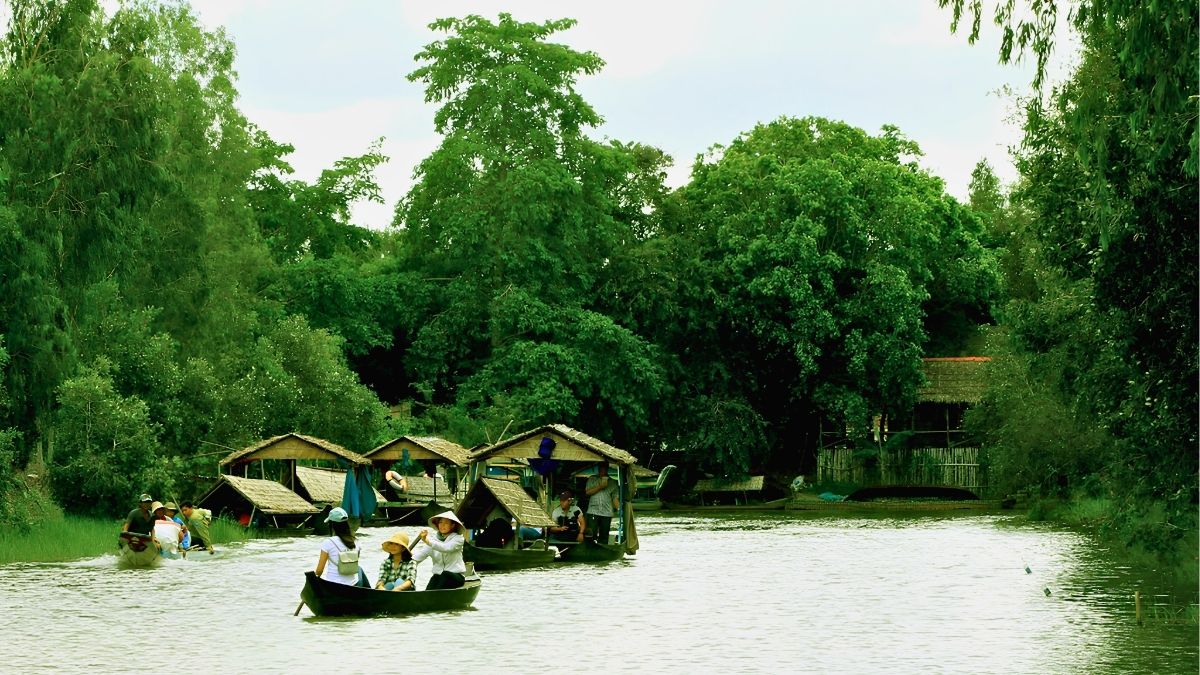 The best time to visit Tram Chim is from December to April (Source: Bao Thanh Nien)
Time of day matters, too. Early morning, around 5:30-7:00 AM, is cooler and generally better for birdwatching in Tram Chim National Park, while late afternoon offers softer light and more comfortable temperatures. Arriving during the hottest part of the afternoon can make wildlife harder to spot and the open wetland less comfortable to explore.
Sarus crane sightings are not guaranteed, even during the dry season. Their population has declined sharply in recent years, so the season should be chosen for the overall wetland experience rather than based on the expectation of seeing cranes.
Read more: Tra Su Cajuput Forest Vietnam: Abandoned amid a verdant paradise
Should you visit Tram Chim National Park just to find the cranes?
No, not if seeing a sarus crane is the only reason for your trip. At its peak, Tram Chim recorded more than 1,000 cranes in a single season, making it one of the most important crane sites in mainland Southeast Asia. But the population fell sharply over the following decades, partly because of changes in water management and growing pressure on wetland habitats across the Mekong Delta. By 2022-2023, park surveys recorded zero cranes, a difficult period for a park whose reputation had become closely tied to this species (Source: Viet Nam Plus).
The situation is now changing, but recovery is still underway. A reintroduction program is bringing captive-bred cranes from Thailand to Tram Chim from 2025 to 2032, with the goal of building a population that can eventually survive in the wild. For visitors, however, this does not mean crane sightings are guaranteed. Seeing a reintroduced crane under close monitoring is also different from coming across a wild flock feeding in the wetland at dawn.
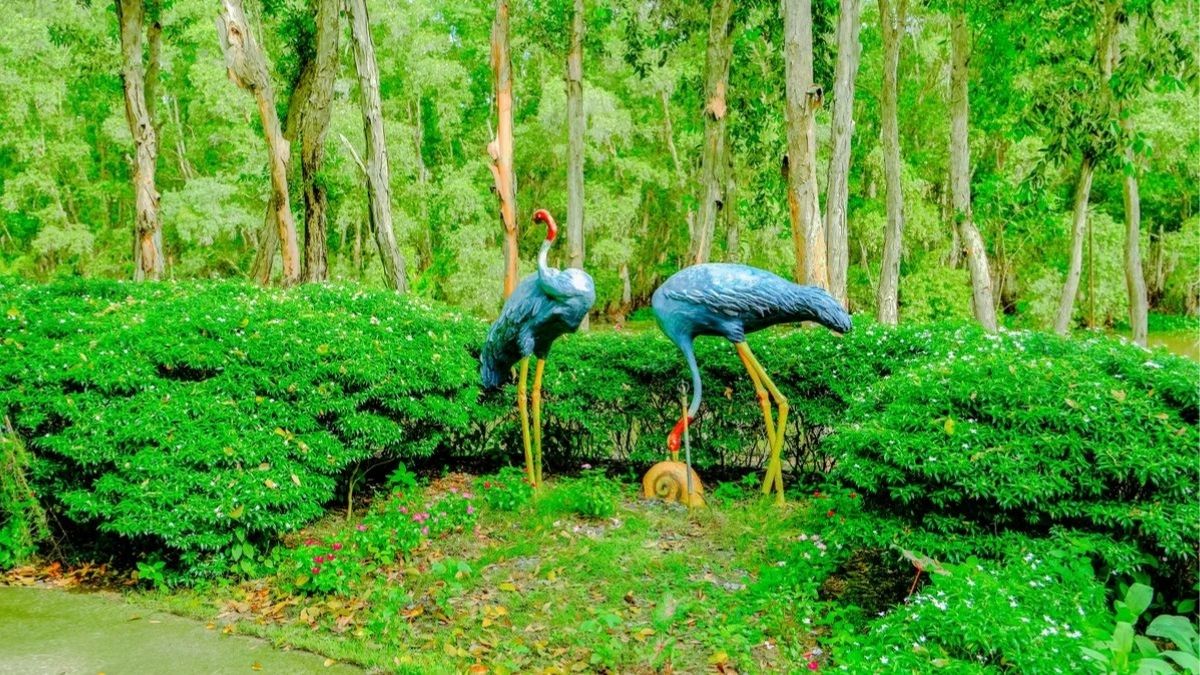 Seeing a monitored reintroduced crane differs from spotting a wild flock at dawn (Source: VTV)
For that reason, treat cranes as a possible bonus rather than the main reason to visit Tram Chim. The park is still worth experiencing for its wetland landscape, plant life, other bird species, and boat trips through channels that look very different from much of the Mekong Delta. The crane conservation story is an important part of Tram Chim, but it is not the whole experience.
What else is there to see besides the sarus crane?
The plants that shape Tram Chim's landscape
Tram Chim is home to a mix of wetland plants that change with the water level and season. Wild rice (Oryza rufipogon), sometimes called "ghost rice" and valued by researchers as a genetically resilient ancestor of cultivated rice, grows across the grasslands, while Melaleuca trees, lotus, water lilies and other water-loving plants fill different parts of the park. Together, they create the open green landscape that makes Tram Chim look very different from the fruit orchards and river towns elsewhere in the Mekong Delta.
The scenery is particularly different between the dry and wet seasons. Exposed grassland and mudflats become more visible when the water is low, while rising water covers parts of the grassland and brings more aquatic plants into view. If you want to notice these details, avoid treating the landscape as background scenery and take time to look at the different types of vegetation around you.
Birds worth watching for beyond the crane
Tram Chim's bird checklist is long - park authorities and biodiversity records put the number at more than 230 recorded species, close to a quarter of all bird species found in Vietnam, so there is plenty to watch even when sarus cranes are absent (Source: Vietnam Tourism). Depending on the season and location, visitors may see Asian openbill storks (which began nesting here by the thousands after a large colony first formed in 2016), pelicans, herons, egrets, ducks and other wetland birds. Migratory species also add more variety at certain times of the year.
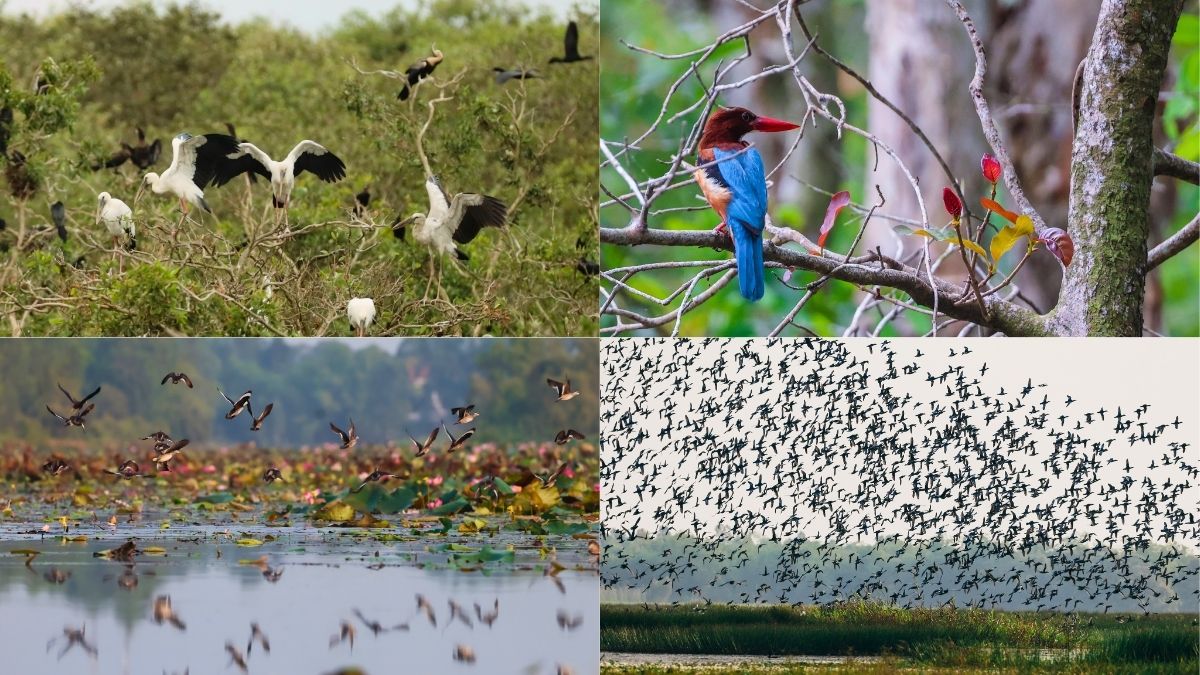 Tram Chim's bird checklist is long (Source: VnExpress)
A pair of binoculars is useful, especially for smaller birds sitting farther away in the grass or trees. A phone camera can capture larger birds, but it may struggle with wildlife at a distance, so don't expect every sighting to make a clear photo. Early morning is also more comfortable for watching wildlife because the light is softer and the weather is usually less harsh than around midday.
Wear light, breathable clothes and comfortable shoes, and bring a hat, sunscreen and drinking water. Long trousers are practical if you will spend several hours outdoors, while neutral-coloured clothing can make it easier to observe wildlife without drawing as much attention.
The boat ride through the wetland
The boat ride is one of the main ways to experience Tram Chim, taking visitors through open wetlands, Melaleuca stands, flooded grasslands and narrow channels where waterbirds gather. Instead of seeing the park from one fixed viewpoint, you move through different parts of the wetland and see how the landscape changes along the way.
Here are the main motorboat options currently listed by Tram Chim National Park:
|
Route |
Departure point |
Distance |
Capacity |
Price |
|
Route 1: Motorboat + electric vehicle |
A3 rest stop |
20 km round trip |
Up to 20 guests |
800,000 VND/trip |
|
Route 2: Motorboat |
C4 rest stop |
12 km round trip |
Up to 10 guests |
500,000 VND/trip |
Both routes operate from 7:00 AM to 4:00 PM. Since the price is charged per trip, sharing a boat with family or friends can make the cost more reasonable. The two routes also differ in distance and departure point, so check which one is operating when you arrive rather than assuming every visitor follows the same itinerary.
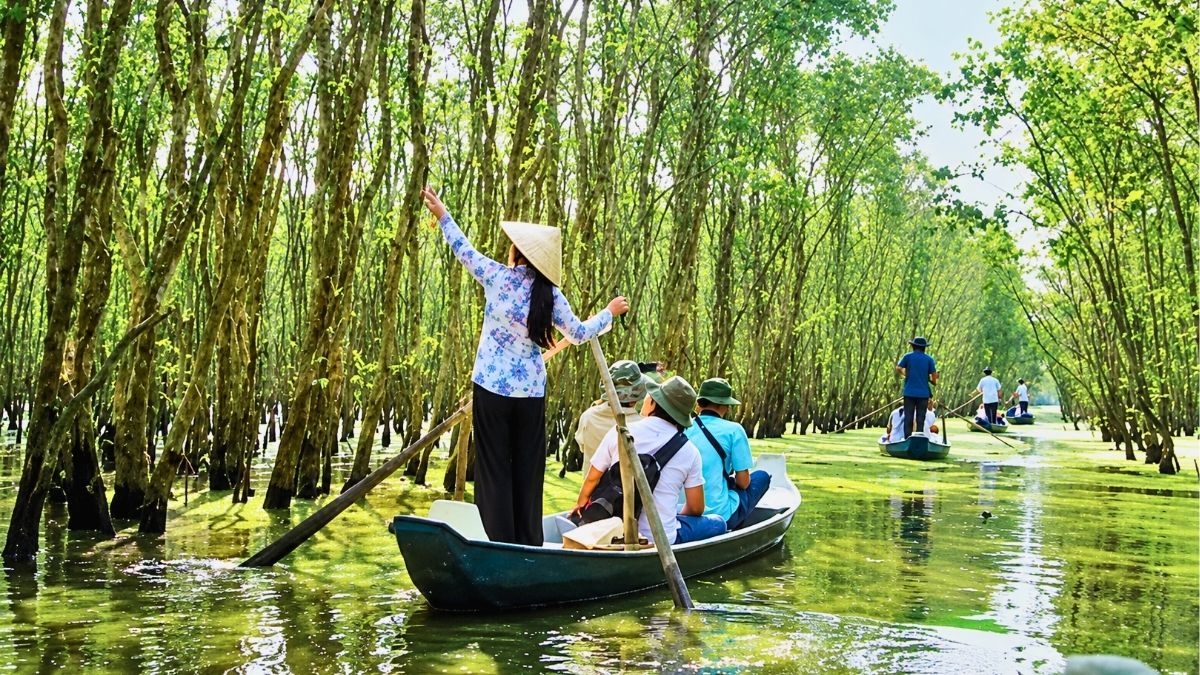 The boat ride through the wetland (Source: dantocmiennui.baotintuc.vn)
If you want more than a sightseeing ride, ask whether a guide can accompany your group. This can be useful for visitors unfamiliar with wetland plants and bird species, as a guide can point out wildlife that is easy to miss and explain what you are seeing. Tram Chim also offers a separate breeding-bird-site experience, which involves travelling about 3 km from the reception area to the A2 forest with a guide accompanying visitors. (Source: tramchim.net.vn)
One practical point: because the listed price is charged per trip, ask about the boat's current capacity and whether other visitors can share the trip if you are travelling as a small group. This can help avoid paying for more capacity than you need.
Should you take the boat in the morning or late afternoon?
Late afternoon can give the wetland warmer light and a different atmosphere, and during flood season roughly September to December, this is also when lotus and water lily blossoms spread across the wider canals, adding color that isn't there in the drier months. Morning may suit visitors who want to focus more on wildlife, when narrower dry-season channels bring nesting birds into closer view.
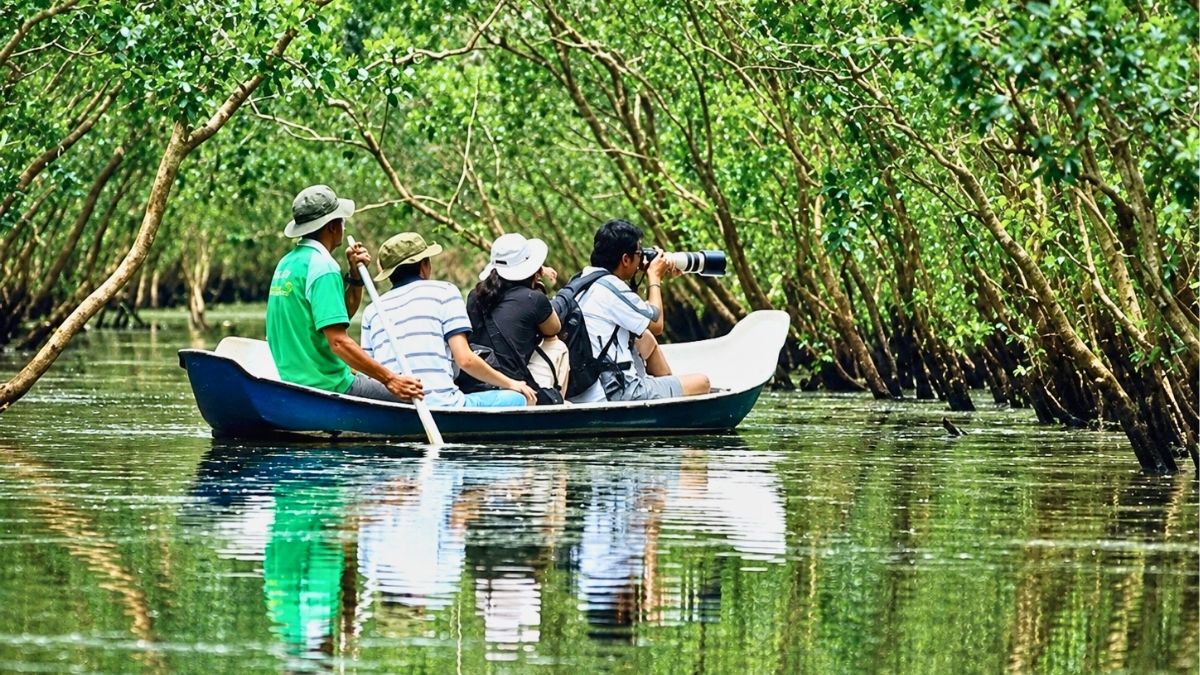 Morning may suit visitors who want to focus more on wildlife (Source: VnExpress)
Can you visit Tram Chim National Park from Ho Chi Minh City in a day?
Yes, a day trip from Ho Chi Minh City to Tram Chim is possible, although the journey takes a large part of the day. The park is around 145-150 km away, with a travel time of roughly 3-4 hours each way, depending on the transport and road conditions. A common route goes through Trung Luong - Tan An - Tan Thanh.
- Private car: The more practical choice for a same-day trip, as you can leave Ho Chi Minh City early, arrive according to your preferred schedule, and return when you're ready. This also gives you more flexibility if you want to add another stop in Dong Thap.
- Bus: Still possible for a day trip, but the fixed timetable can make the schedule tighter. Check both the departure and return times before booking to make sure you have enough time at Tram Chim.
For a same-day visit, starting early is important. Spending 6-8 hours on the road leaves limited time at the park, so a private car generally gives you more flexibility over the day's schedule.
Read more: Mekong Delta Day Trip from Ho Chi Minh City: Itinerary, Cost & Tips
Suggested itinerary: Fitting Tram Chim into a Mekong Delta Trip
Tram Chim is easier to fit into a Mekong Delta trip when you treat it as one stop on a wider route. Depending on how much time you have, these itineraries give you a practical way to combine the wetland with nearby destinations.
|
Duration |
Suggested route |
Best for |
|
1 day |
Ho Chi Minh City → Tram Chim → Ho Chi Minh City |
A quick visit focused on the wetland |
|
2 days |
Ho Chi Minh City → Cao Lanh → Tram Chim → Ho Chi Minh City |
Combining Tram Chim with Dong Thap |
|
3 days |
Ho Chi Minh City → Cao Lanh → Tram Chim → Chau Doc → Ho Chi Minh City |
A broader Mekong Delta experience |
Sinh Cafe Travel can help arrange a wider southern Vietnam itinerary, with options such as its 5 Days 4 Nights in South Vietnam tour for a longer Mekong Delta journey or the Ho Chi Minh City 1-Day Tour for a shorter city stop before heading into the delta. If you want to combine Tram Chim with other destinations and have the transport and logistics arranged for you, visit Sinh Cafe Travel to explore more Vietnam tour options.
 Sinh Cafe Travel can help arrange a wider southern Vietnam itinerary
FAQs
What is Tram Chim National Park famous for?
Its wetland ecosystem, sarus cranes, and status as Vietnam's fourth Ramsar site.
Can you still see sarus cranes at Tram Chim today?
Sightings are not guaranteed. The park recorded zero cranes in 2022-2023, while a reintroduction program from Thailand is underway through 2032.
How does Tram Chim change during the flood season?
Higher water levels flood more grassland and wetland areas, creating a fuller landscape and changing where birds gather.
Should I visit Tram Chim during the flood season or dry season?
The dry season generally offers easier boat access, while the flood season shows more extensive flooded wetlands. Check current water levels and boat routes before visiting.
How long does a boat trip at Tram Chim last?
Shorter routes take about an hour, while longer routes can take a couple of hours, depending on the route and water conditions.
Share via




Related articles
Visit Ha Giang in November: Is it a good time to go?
Posts | 21/09/2026

Ha Long bay 1 day tour: Best itinerary, cruise options & Travel tips
Posts | 23/03/2026
Yang Bay Waterfall: A Hidden Paradise near Nha Trang you shouldn’t miss
Blog | 24/03/2026

Diep Son island: Walk across the sea in Vietnam’s hidden paradise
Posts | 24/03/2026






There are no reviews yet